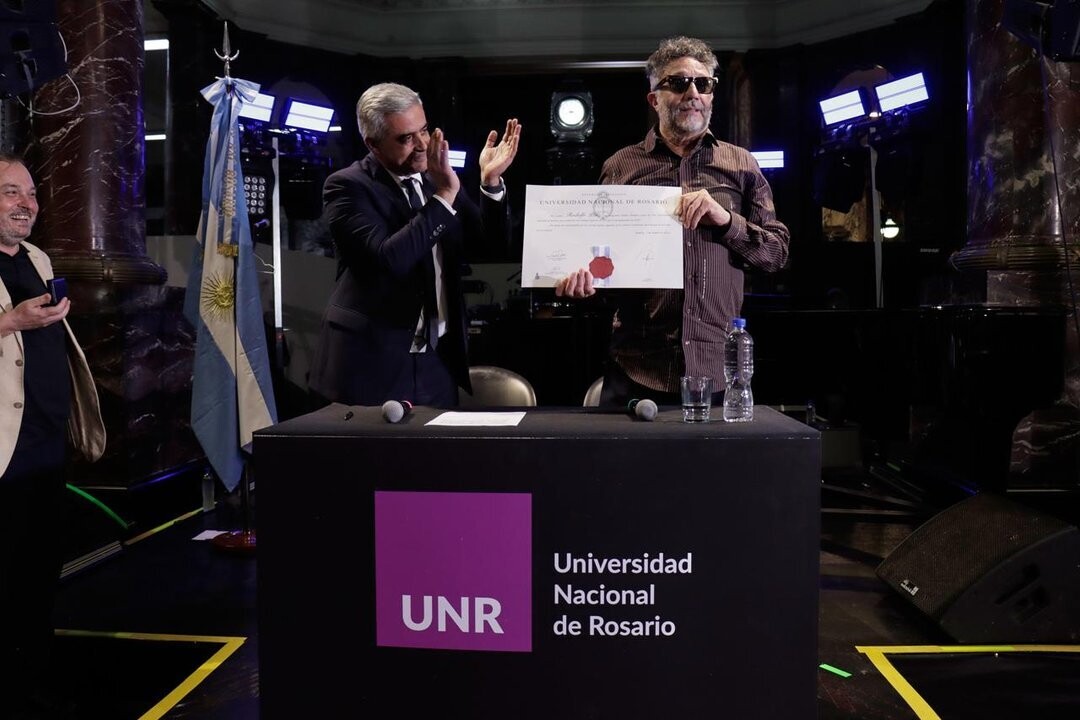
Yesterday afternoon, musician Fito Páez was distinguished with the title of Doctor Honoris Causa in an act held at the University of Rosario in recognition of his career. According to what the Argentine News Agency could verify, the musician recalled experiences from his childhood in Villa Constitución with his aunt Charito and highlighted 'expression as a central element of humanity.' Páez was moved at the ceremony and wanted to differentiate the 'artist' Fito from the Fito from Rosario. 'I am here doing what I always do. I am the son of my mother and my father,' he said. He also referred to the artistic honesty that musicians must have when they allow third parties to mock their way of expressing themselves. 'What is not negotiable is when you are in your room, alone. Those who allow themselves to be intervened cannot belong to the noblest causes,' he added. The musician thanked those who inspired him and were part of his artistic path, mentioning Baglietto, Abonizio, Fandermole, and Liliana Herrero. 'This is a recognition of the movement I come from. It has my face, but it is collective, for those kids who during the dictatorship had courage in a rehearsal room,' he stated. The tribute included a concert specially designed for the occasion, with Rosario musicians: Matías Galasso on piano and keyboards, Ricardo Vilaseca on keyboards, Leandro Pagura on bass, Agustín Borsini on drums, and Guido Luján on guitar. Fito also shared the stage with friends and long-term collaborators, such as Coki Debernardi ('Linyera') and Carlos Vandera ('A la casa'), reinforcing the collective spirit of the tribute. The event included emotional moments, such as the performance of 'Sale el sol' from his latest album 'Novela,' inspired by Villa Constitución, and closed with an a cappella version of 'Yo vengo a ofrecer mi corazón.'